

Round 2 · KladnoDivision 1
Analysis
Playoff adjustments, midfield pressure and a title race reset: What Round 2 revealed about the 1st Division
Read the full article →

The move from Říčany to Kladno transformed the 2nd Division standings, but the dramatic results tell only part of the story. We examine the tactical differences, individual performances and challenges that could decide the Winter Split finale in Domažlice.
The second round of the Czech Laserball League delivered a striking demonstration of how much competitive performance can change between arenas. Aurora Legion Purple went from eighth place to an unbeaten gold-medal performance, Legion Yellow climbed from last to third, and previously dominant Bagrýk 34 dropped out of the playoffs altogether. Meanwhile, Kočičí démoni emerged as the new Winter Split leaders without winning either of the first two tournaments.
The results were dramatic, but they also raised some interesting questions. How much of the Kladno teams' improvement came from home advantage, and how much from better tactical organization? Why did some of the strongest Říčany teams struggle despite preparing extensively for the change of venue? And what enabled Kočičí démoni to remain competitive in two arenas that rewarded noticeably different approaches?
With one round remaining before the promotion playoffs, the answers could offer an early indication of which teams are best equipped to compete at a higher level.
One of the most important differences between the opening two rounds was the amount of space available to challenge possession. Říčany's expansive layout had offered several opportunities for experienced ball-carriers to remain concealed or control passages of play from relatively protected positions. Kladno's narrower, elongated arena made those situations much harder to reproduce, with fewer isolated pockets and more overlapping defensive sightlines.
The change was particularly apparent in the way teams organized their midfield. During Round 1, several less experienced lineups struggled to pursue an opposing ball-carrier without opening significant gaps in their own defense. In Kladno, the more compact arrangement allowed players to cover multiple approaches with relatively small adjustments in positioning, making it easier to challenge possession while maintaining defensive support.
That did not necessarily mean that every match became faster or that patient possession was suddenly ineffective. Rather, players attempting to retain the ball often needed to work harder to protect it, anticipate pressure and find supporting teammates. Teams that had been comfortable dictating the tempo in Říčany were forced to make decisions under more immediate pressure.
The differences between Kladno's two bases also played an important role. The Blue side offered a comparatively narrow defensive approach, allowing defenders to control several sightlines from relatively protected positions. Once attackers successfully entered the base, however, defenders could find it difficult to recover their position or escape repeated resets. Green was more open across its approach lanes, making defensive positioning particularly demanding for teams unfamiliar with the layout.
Both Legion teams demonstrated considerable confidence defending Green, where they were familiar with the available angles and how to cover them. Several visiting teams appeared more comfortable on Blue, although that preference did not always translate into effective defense once opponents established sustained pressure.
The value of that familiarity was evident throughout the day, but the strongest teams also demonstrated that knowing an arena is only one part of successful play. Purple, Yellow and the leading visiting sides still needed to communicate effectively, coordinate their movements and make good decisions when possession changed hands.
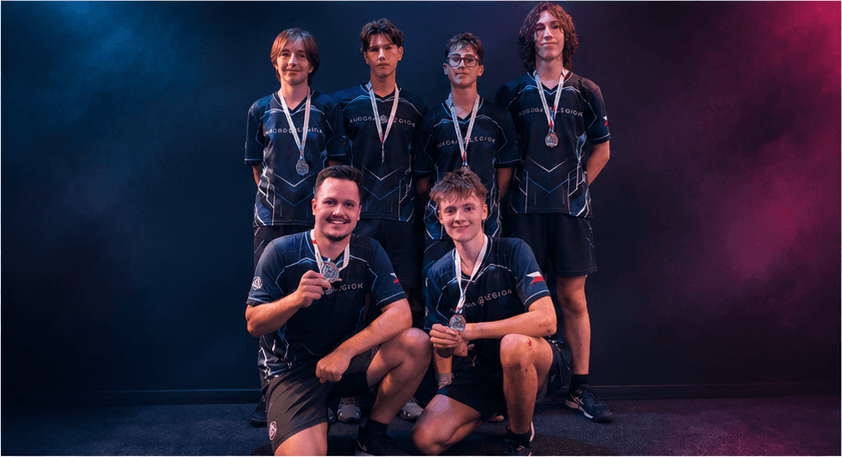
Aurora Legion Purple's improvement was extraordinary even by the standards of a competition designed around changing venues. After winning just one match in Říčany, the Kladno lineup completed Round 2 with ten consecutive victories and an impressive 80:26 goal record.
Their performance was not simply a case of attackers suddenly finding more opportunities. The entire team appeared more coordinated, particularly in the way it converted defensive recoveries into attacking possession.
Gengar played a crucial role in that process. Operating primarily in defense, he repeatedly managed to recover the ball and immediately identify teammates moving into attacking positions. Rather than simply clearing danger away from the target, he turned defensive actions into opportunities to score, often finding Matthew, WeterosCZ or George before the opposition could reorganize.
That distinction became especially apparent against SK Domažlice in the semifinal. Both teams had exceptionally effective individual defenders, with Hellcat repeatedly preventing Purple from scoring. Yet the outcome of their defensive interventions was often different. Domažlice sometimes struggled to find safe passing options after recovering possession, while Purple were consistently able to move the ball into space and maintain attacking pressure.
The attacking movement ahead of Gengar completed the system. WeterosCZ, Matthew and captain Skotík 39 repeatedly created openings through well-timed runs, while George demonstrated outstanding finishing ability. Named Best Attacker by the commentary panel, George was one of the most productive players in the competition, regularly converting the opportunities created by his teammates.
Purple also showed a willingness to contest possession immediately at the beginning of a point, occasionally committing all six players forward before reorganizing their defense. The approach carried obvious risks, but the team generally executed it with enough coordination to establish early control.
The result was a side capable of maintaining attacking pressure without consistently exposing its own target. Home advantage helped Purple execute those patterns with confidence, but their success ultimately came from the effectiveness of the entire system.
Whether they can reproduce that level of organization away from Kladno will be one of the most important questions heading into Round 3.
Aurora Legion Yellow's turnaround was nearly as remarkable as Purple's, although the two teams achieved their success in somewhat different ways.
Yellow had struggled throughout the opening tournament, particularly when attempting to cover Říčany's wider playing area and identify opponents holding possession in unfamiliar positions. Their young lineup frequently found itself reacting to the opposition rather than imposing its own style.
In Kladno, those difficulties were much less apparent. The players were comfortable with the arena's movement routes and defensive angles, allowing them to make decisions more quickly and concentrate on creating opportunities rather than searching for opponents.
The improvement was evident in their attacking coordination. Vixtrax and Lonklo were particularly effective at maintaining pressure, while Miky helped organize the team's movement. Punisher, Zui and GladPear contributed important attacking moments, demonstrating that Yellow could create opportunities through several different players rather than relying on isolated individual breakthroughs.
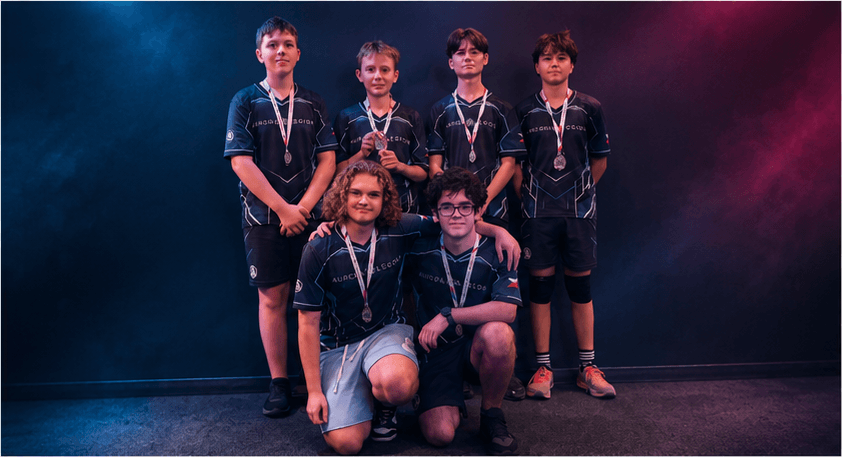
Their defensive performances also improved, most notably through Kuba-M. His contribution in the bronze-medal match was exceptional, with the supplied tournament recap recording a +34 block differential during the second half. That level of defensive efficiency provided an important foundation for Yellow's attacking recoveries and helped them secure their first CLBL medal.
Perhaps the most encouraging aspect of Yellow's performance was their response to difficult situations. The team showed composure during close group-stage encounters, recovered from deficits and fought back from a seemingly lost position against Kočičí démoni in the semifinal. Although they eventually lost in overtime, their ability to force the additional period demonstrated a level of determination and coordination that had been much less apparent in Říčany.
It would be misleading to attribute the entire improvement to the change of venue. Familiarity with Kladno certainly provided an advantage, but the experience gained during Round 1 also mattered. Yellow had already faced several established teams under difficult conditions, and the second round offered an opportunity to apply those lessons in a more familiar environment.
The challenge now is translating that progress to Domažlice. A third-place finish has moved Yellow back into the promotion conversation, but their performance at another away venue will reveal whether their improvement extends beyond home conditions.
Among the visiting teams, Kočičí démoni provided perhaps the strongest example of successful tactical adaptation.
Their bronze-medal performance in Říčany had relied heavily on controlled possession, with Karol frequently retaining the ball for extended periods while teammates waited for favorable attacking opportunities. That approach was particularly effective against opponents who struggled to locate or challenge the ball-carrier, but Kladno presented a more demanding environment.
Rather than attempting to reproduce the same system unchanged, Kočičí démoni demonstrated a greater willingness to challenge possession actively and commit additional players forward.
The change was especially noticeable in their decisive group-stage encounter against Chaos Protocol. Facing a direct rival for playoff qualification, the team adopted an unusually aggressive opening approach, pushing players into midfield and establishing control before their opponents could settle. It was a significant departure from the slower style that had characterized much of their opening tournament.
Karol remained central to their performance, but her role became more varied. She continued to control possession when appropriate while also contributing to more active midfield pressure and coordinated attacking sequences. Her ability to adapt was recognized with the Best Midfielder award, providing further evidence that effective ball retention depends on understanding when to slow the game and when to accelerate it.
The team's attacking options also became more diverse. Číla and Galaxy contributed important goals, while Fífa's introduction offered additional possibilities around the opposition target. Jardys continued to provide a reliable defensive foundation, allowing his teammates to adjust their positioning without completely abandoning the structure that had worked in Říčany.
Their response to the exhausting overtime semifinal against Yellow was particularly revealing. Having surrendered a late advantage, Kočičí démoni could easily have lost momentum. Instead, they recovered their organization and controlled the additional period, demonstrating an ability to adjust under pressure as well as between matches.
Purple ultimately proved too strong in the final, but Kočičí démoni leave Kladno with a result that may be more valuable in the longer term than another isolated tournament victory. Bronze in Říčany and silver in Kladno have made them the most consistent team in the division, putting them at the top of the Winter Split standings.
Their performance suggests that they can preserve the strongest elements of their established style while adapting to very different conditions — precisely the quality the league's multi-arena format is intended to test.
Bagrýk 34 entered Round 2 with considerable momentum. Their perfect opening tournament had established an exceptionally effective attacking system, with Mrejk controlling possession in midfield while Mejval and Mrazík repeatedly broke through opposing defenses.
In Kladno, those patterns were much harder to establish.
The change of arena reduced the opportunities for uncontested possession, while opponents were generally better positioned to challenge the ball before Bagrýk could organize its attacks. Several teams also appeared better prepared to respond to the rapid transitions that had been so effective in Říčany.
The difficulties were evident from the opening encounter against Chaos Protocol. Bagrýk established a substantial advantage but struggled to protect it as the Prague side increased its pressure. Further difficulties followed against Flying UHU and both Legion teams, leaving the defending champions outside the playoff positions.
Personnel changes added another complication. Established defender Matlafousek missed the tournament through injury, with Adámek joining the active lineup while Matlafousek supported the squad from the bench. The absence required adjustments to a defensive structure that had been highly effective during Round 1.
It would be difficult to determine precisely how much of Bagrýk's decline resulted from that change, the different arena conditions or the improved performances of their opponents. More likely, several factors combined to make their previous approach less effective.
Importantly, the team's attacking ability did not simply disappear. Mrazík, Mejval and Mrejk continued to produce dangerous individual moments, and Bagrýk finished with a positive goal difference despite managing only two victories in eight group-stage matches.
That combination illustrates one of the challenges of tournament competition. A team can remain capable of scoring and defending effectively in individual situations while struggling to convert those performances into consistent results against direct rivals.
The contrast between Bagrýk's first two tournaments is one of the most interesting developments of the inaugural season. Their commanding victory in Říčany demonstrated the quality of their players and coordination, but Kladno exposed the need for greater flexibility when the preferred attacking patterns are disrupted.
With 13 Winter Split points, Bagrýk remain second overall. Their immediate priority in Domažlice will be finding ways to apply their attacking strengths without depending on the same conditions that made them so successful at home.
While the dramatic changes at the top attracted most of the attention, the performances of SK Domažlice, Chaos Protocol and Kobry a Užovky may prove equally important when the Winter Split reaches its conclusion.
Domažlice demonstrated significant resilience by reaching the semifinals without Killer Elmo, one of their most dangerous attacking players. Botwea, Triman, Emka and Barča helped maintain the team's offensive capabilities, while Hellcat delivered the tournament's standout defensive performance.
Hellcat's recognition as Best Defender was well deserved. He repeatedly kept Domažlice competitive through exceptional positioning, blocks and defensive recoveries, including a remarkable individual display against Purple in the semifinal. Yet the team's difficulties in converting those recoveries into attacking opportunities revealed an area that could become particularly important in the final round.
Domažlice have shown they can compete with the strongest opponents, but their next challenge is turning effective individual performances into greater consistency. Returning to their home arena in December provides an opportunity to achieve that, although the venue's recent redesign means even the hosts will need to adapt.
Chaos Protocol also demonstrated encouraging development. The Prague team had undertaken extensive preparation in Kladno, and their opening draw against Bagrýk illustrated the benefits of greater familiarity with the arena. Atreyu, Tsunami and Taxikář contributed to several effective performances, while Nirchik joined the lineup in place of Thomiiik and offered additional attacking options.
Nevertheless, their results also highlighted the difference between competing effectively in individual encounters and maintaining that standard throughout a tournament. Chaos Protocol were capable of recovering from difficult positions but struggled against teams that established sustained attacking pressure, particularly Kočičí démoni. Their fifth-place finish leaves them well within reach of the promotion places, but greater consistency will be needed in Domažlice.
Kobry a Užovky face a similar challenge after dropping from second to seventh. Their experienced lineup had been particularly effective in Říčany, where Šmoula's attacking positioning and the team's knowledge of the arena created valuable advantages. In Kladno, those strengths proved less reliable, and the team struggled to find the same level of attacking efficiency.
Their difficulties were particularly evident in close encounters. The defeat against Fénixové, a team they had previously been able to contain more effectively, demonstrated how quickly the outcome of a match can change when an opponent finds momentum and the defensive structure cannot recover.
Despite their disappointing result, Kobry remain tied on 11 Winter Split points with Purple, Domažlice and Chaos Protocol. Their strong opening tournament therefore keeps them firmly in contention, even as the pressure increases ahead of the final round.
Flying UHU and Fénixové also deserve recognition for producing two of the most surprising results of Saturday's competition. Flying UHU's victory over defending champions Bagrýk demonstrated the potential of their revised lineup, particularly the attacking contributions of Lennyfy and Zero, while Fénixové's dramatic comeback against Kobry provided a memorable reward for their persistence.
Neither team has yet demonstrated the consistency required to challenge for a leading position, but their performances reinforced an important characteristic of the division: even teams near the bottom of the standings are capable of influencing the championship race by defeating higher-ranked opponents.
With the Winter Split approaching its final tournament, the championship standings present a fascinating contrast between dominance and consistency.
Bagrýk 34 and Aurora Legion Purple have each won a tournament without losing a single match, yet neither currently leads the overall standings. That distinction belongs to Kočičí démoni, whose third- and second-place finishes have produced 15 placement points across the first two rounds.
Bagrýk remain second with 13 points, while Purple, SK Domažlice, Chaos Protocol and Kobry a Užovky are tied on 11. Purple currently hold the third promotion position through the tiebreaker favoring the most recent round's result, but the margins are extremely small. Aurora Legion Yellow are also within reach on eight points after their impressive recovery in Kladno.
The situation illustrates the importance of the league's placement-based scoring system. Winning a round provides a significant advantage, but a poor result at another venue can quickly reduce it. Conversely, teams that consistently reach the playoffs or finish near the top can remain competitive even without claiming gold.
That makes the final Winter Split round at STAR DOMS Domažlice on 12 December particularly significant. The three highest-ranked teams will earn the opportunity to compete for promotion to the 1st Division, and several contenders still have realistic routes into those positions.
For Domažlice, the home tournament represents an opportunity to capitalize on familiar surroundings after two competitive but ultimately frustrating performances. Purple and Yellow will be attempting to demonstrate that their improvement in Kladno was not limited to their home arena, while Bagrýk must recover from its difficult second round. Kočičí démoni will be looking to maintain their remarkable consistency, and both Chaos Protocol and Kobry have opportunities to move back toward the leading positions.
The first two tournaments have shown that no single playing style guarantees success across different venues. Říčany rewarded teams capable of exploiting its spacious layout and controlling possession, while Kladno demanded faster reactions, coordinated pressure and effective transitions between defense and attack. Domažlice will introduce another environment, with a redesigned arena that poses new challenges for nearly every team in the field.
For clubs pursuing promotion, that variety is arguably the most important lesson of the season so far. Individual attacking quality, defensive skill and home-arena knowledge can all produce outstanding results, but success across an entire split requires teams to combine those strengths with preparation, communication and adaptability.
After two rounds, the 2nd Division has produced two very different unbeaten champions and a championship leader that has yet to win a tournament. With so little separating the promotion contenders, the final result may depend less on which team has been strongest at any one venue than on which can respond most effectively to the next change of conditions.
Říčany rewarded the teams that knew its secrets. Kladno gave the home teams their chance to respond. Domažlice will decide who has adapted best across the Winter Split.
Analysis
Report
Report